
All blogs
-
54% of smaller firms losing trade post-Brexit, says new report
February 11, 2026
A new report shows that 1 in 5 UK exporting manufacturers have struggled with trading with the EU since 2020.
Analysis by Make UK and DHL reports that 19% of companies surveyed said that their trade with EU markets had reduced and remained lower since 2020.
Among businesses with between 10 to 249 employees, that figure jumped to a massive 54%, showing that smaller firms have suffered more in the post-Brexit trading relationship, citing higher costs, increased red-tape and business uncertainty.
The report is available to download here. The survey sampled 119 UK exporting manufacturers.
It comes on the day that the Business and Trade Committee said that small firms in the UK were operating under ‘pandemic-style pressures’, calling for urgent reforms.
Dr Mike Galsworthy, Chair of European Movement UK, said:
"How many more manufacturers have to lose business before Westminster stops treating EU trade as a culture war footnote? Every month we delay dynamic alignment or a proper sanitary and phytosanitary (SPS) agreement, more contracts move to Rotterdam or Düsseldorf and never come back. The UK-EU reset cannot just be a summit photo, it must mean market access.
"We are voluntarily stepping away from the team we should be captaining. That is not sovereignty, it is self-sabotage. This research shows the true cost of a bad deal. It is time to stop managing decline and start rebuilding a trading relationship that actually works for British industry."
Keir Starmer is right: Single Market is the clear way forward
February 03, 2026
CEO of European Movement UK, Sir Nick Harvey, looks at why Keir Starmer is right to look at the Single Market as a solution for the UK.
Late last week, speaking to reporters during his recent visit to China, Prime Minister Keir Starmer said that he wants to “go further” in aligning the UK with the EU Single Market because it is “in our national interest.”
He also said this on Laura Kuenssberg’s show at the start of the year. And he has said this, twice publicly now, for good reason – both the numbers and the public back it.
The numbers support it
The Single Market remains the largest trading bloc in the world, responsible for 41% of the UK’s exports in 2024, and its absence is felt every day by British firms.
Through leaving the Single Market, in the UK we are exporting less, we are employing fewer people and prices are going up.
For the UK, joining the Single Market would:
- Eliminate trade barriers for most goods and services
- Control and even lower consumer prices
- Allow capital, goods and people to move freely.
There is also increasing talk in Westminster of the UK negotiating a customs union with the EU. This idea is being driven forward by the Liberal Democrats, the Greens, Labour backbenchers and even Health Secretary Wes Streeting and Deputy Prime Minister David Lammy.
Joining the customs union would undoubtedly have benefits, but those would be much more significant if coupled with closer alignment with the Single Market – and even more if we actually join it.
The Institute for Fiscal Studies stated that joining the Single Market would add a 4% increase to the UK’s GDP.
The Office for Budget Responsibility (OBR) maintains that being outside the Single Market has reduced the UK's overall trade intensity (integration into the global economy) by roughly 15%. The UK is a huge market for the EU, providing 51% of the bloc’s imports. Both parties have an interest in increasing the trade intensity between us and, especially on the UK side, of moving back up from the 15% decrease.
For more on the numbers underlining the economic impact of the UK leaving the EU, see a wide range of sources in our recent news piece here.
Now, where the PM says ‘alignment’ with the Single Market, the evidence says that we should go further – join the Single Market.
Alignment with the Single Market leaves the UK as a ‘rule-taker’, as we are now.
Joining it without being an EU member state will mean the same, but to a lesser extent as the UK would be closer to the table and consulted much more.
Alignment means lingering customs checks. Joining it will eliminate customs checks.
Joining also means annual payments, but these would be far outweighed by the economic boost that joining the Single Market would bring. Some of the initial reports on this suggest that the annual contribution is anywhere between £8-9billion, whilst the projected added value is around £80-90billion.
This is why the answer is not alignment with the Single Market, but joining it fully. This will bring genuinely huge benefits to an economy which needs a sustained shot of adrenaline.
The public support it
For example, a recent poll by Opinium, commissioned by European Movement UK, found that 75% favour joining the Single Market to lower taxes.
Another poll in December 2024 by the European Council on Foreign Relations found that a “majority (54%) of Britons who voted to leave the EU would now accept a return to free movement in exchange for access to the single market”
More than joining the Single Market, a YouGov poll in early January of this year found that “50% of British voters would now choose to rejoin the European Union”.
Even a quick search online and you will find a lot of polls telling the same story.
Time to join, not align with, the Single Market
Across the UK, something has shifted in the conversation about Europe. In communities, in boardrooms and now, increasingly, in Downing Street, there is a growing acceptance in the UK that the story we were told about life outside the EU does not match the experience people across the UK have endured over the past few years.
Now, after a long period of denial, the party of government has begun to acknowledge what many of us, including Keir Starmer himself, have said since 2016: Britain’s prosperity is bound up with the success of our closest neighbours.
The government’s current red lines on Europe were presented as fixed, yet they are already bending under economic pressure, but this should not surprise anyone. When growth is weak and public finances are stretched, clinging to self-imposed limits becomes harder to justify.
This is not about replaying old arguments or questioning how people voted nearly a decade ago. This is about recognising where we are now and deciding where we want to be. The national interest is not served by pretending that isolation has made us stronger. It is served by facing facts and acting on them.
Britain is a European country by geography, by history and by shared values. This is why bringing the UK back to the heart of Europe and the Single Market is not a leap into the unknown. It is a practical step towards economic renewal and a more confident role in the world.
Brexit's 6th Birthday. Who's Celebrating?
January 30, 2026
The UK officially left the European Union on 31st January 2020. Tomorrow marks 6 years since its exit from the bloc, amid promises of flourishing trade, increased border controls and cash boosts for the NHS.
But none of this has happened.
There are few now who think Brexit has been kind to the UK, politically, economically or socially. Polls regularly show a clear majority of the public now favours rejoining the EU.
Here's what has happened:
- Brexit has cut the UK economy by up to £140 billion (Cambridge Econrometics)
- The UK could be more than £300 billion worse off by 2035 (Cambridge Econometrics)
- Export barriers have added an estimated £8.4bn in costs (NFU/Parliamentary Select Committee)
- Goods trade has decreased by an estimated 18% (NFU/Parliamentary Select Committee)
-
Food and drink trade with the EU has dipped by 24% (NFU/Parliamentary Select Committee)
- By 2025, Brexit had reduced UK GDP by 6% to 8% (King's College London/NBER)
- UK investment is up to 18% below pre-Brexit levels (King's College London/NBER)
-
Employment and productivity down 3-4% (King's College London/NBER)
- Brexit is on course to cut UK trade intensity by 15% (OBR)
Sir Nick Harvey, CEO of European Movement UK, said:
"There are very few now who will say with a straight face that Brexit has brought any benefits to the UK. Six years on from the UK's official exit from the EU, it's clear that we have all been bruised in a thousand different ways from our decision to detach ourselves from our largest trading partner.
"The economy has struggled, businesses have battled against new red-tape that has seen many strangled out of trading with the EU at all, and the UK's international reputation has been hammered.
"We are most of us poorer because of its severe economic damage, our young people have been hamstrung by the removal of their ability to live and study in Europe, and our political landscape has been fractured by a decision that continues to divide, rather than unite. The promised sovereignty feels hollow when weighed against the tangible loss of influence, opportunity and shared purpose. What was sold as liberation has, in reality, become a lesson in the profound costs of isolation.
"It is encouraging that the government now appears to be taking seriously its promise of resetting the relationship between the UK and the EU. However it is yet to translate into the economic benefits that are available on our international doorstep. It must now look at erasing some of its own red lines, starting with the profound benefits that access to the EU's Single Market would bring."
Europe must confront the end of Pax Americana
January 20, 2026
Europe must confront the end of Pax Americana, writes Public Affairs Manager, Joe Meighan.
International politics moves in eras. For decades, Europe’s security rested on a stable assumption: that the United States would remain a predictable guarantor of the post-war order. That assumption no longer holds. Recent US actions towards Greenland mark a turning point that Europe and the UK can no longer afford to ignore.
Greenland is not an abstract territory on a map. It is part of the Kingdom of Denmark, a sovereign European state and a Nato ally. Yet repeated statements and signals from President Donald Trump, treating Greenland as a transactional asset rather than sovereign territory, represent a deeply troubling departure from the norms that underpin European security. Explicit or implicit pressure on Greenland is not a diplomatic eccentricity; it is an aggressive act that undermines the alliance’s solidarity and international law.
This matters because the United States already enjoys extensive military access and cooperation in Greenland through Denmark and Nato. There is no legitimate security gap to be filled. What is at stake instead is strategic control over the Arctic: its shipping routes, energy reserves and critical raw materials. As climate change accelerates Arctic access, Greenland has become central to global competition. Attempts by a supposed ally to strong-arm a European territory in pursuit of resource and strategic advantage must be recognised for what they are - a challenge to Europe’s sovereignty and security.
The lesson is stark. Aggression in the 21st century does not always arrive in the form of invading armies. It increasingly takes the form of coercion, pressure, leverage and the casual erosion of sovereignty by powerful states that believe rules no longer apply to them. Europe has seen this behaviour from Russia and China, and it should alarm us profoundly to see similar logic emerging from the United States.
For Europe, this confirms a reality that has been building for years: our safety and security now lie primarily with ourselves. Look at Trump’s lack of commitment to support Ukraine with a security guarantee, and look at his approach to Greenland now. The transatlantic relationship remains important, but it can no longer be the foundation on which European defence is built. Strategic autonomy is not anti-American; it is pro-European resilience. It is the recognition that Europe must be capable of defending its territory, its resources and its democratic values, regardless of political volatility in Washington.
This has immediate implications for the UK. Brexit did not change geography, shared threats or shared responsibilities. Britain faces the same challenges as its European neighbours: energy insecurity, cyber-attacks, disinformation, pressure on supply chains and intensifying competition for critical resources. Yet outside the EU, the UK has weakened its own influence and resilience at precisely the moment when unity matters most.
Closer cooperation with the European Union is no longer sufficient. The scale of today’s international crisis demands deeper alignment than that. Participation in common defence procurement, secure supply chains and coordinated sanctions requires full access for the UK to the EU single market and to shared European decision-making, because security and economic strength are inseparable. Without the efficiencies and protections of the single market, Europe and Britain remain vulnerable to external coercion.
This is why the debate must now move beyond technical cooperation to strategic intent. Single market membership is not a concession; it is a safeguard and a peace project. And in the face of an increasingly unstable world, where even allies may behave aggressively, European Union membership must once again be recognised as a legitimate and necessary objective for the UK.
A stronger, more unified Europe does not weaken Nato. On the contrary, it strengthens the alliance by ensuring it is not dependent on the political direction of any single capital. European defence capability, European economic integration and European political unity are the foundations of credible security.
At European Movement UK, we have long argued that sovereignty in the modern world is exercised collectively or not at all. A threat to one European state, whether from Russia, China or indeed the United States, must be treated as a threat to all of Europe. That includes threats to Greenland. The UK government must not continue to mute its response in the hope of currying favour with the White House. Solidarity with our European neighbours must come first.
The era of complacency is over. Pax Americana has ended, not with a declaration, but with a series of actions that reveal a harsher, more transactional world. Europe can either respond divided and diminished, or united and resilient.
For Britain, the choice is clear. Our future security lies in Europe. Our prosperity lies in the single market and our influence lies in rejoining the European Union. European defence is our defence, and Europe’s future must be secured together.
Statement on Trump and Greenland
January 19, 2026
The UK and its European neighbours have a long history of standing up to bullies, writes European Movement UK CEO, and former Minister for the Armed Forces, Sir Nick Harvey.
Let us be clear - attempts by any state to bully another nation or lay claim to its territory undermine the basic principles of international law and collective security on which peace depends.
This morning’s statement from the Prime Minister comes against the backdrop of deeply troubling actions by Donald Trump over the weekend in relation to Greenland. Such behaviour is wholly unacceptable from anyone, let alone from the leader of a country that has long claimed to stand for the rules-based international order.
The UK should not equivocate or hide behind diplomatic niceties when those principles are being challenged so blatantly. We need a coordinated European response, including, where necessary, measures like sanctions or sporting bans, already deployed against Russia for similar actions in Ukraine.
These events underline a reality that has been building for some time. The United Kingdom can no longer rely on the United States to act consistently as a good-faith partner in defence and foreign policy. Our security must rest on predictable partnerships and steady institutions, rather than the whims of an unpredictable White House.
As the special relationship frays, renewed commitment to Europe offers the only credible route. By working far more closely with our European neighbours, politically and economically, and through deeper defence cooperation, the UK can help build a credible, collective European defence grounded in shared values and the rule of law.
Europe is where our security and prosperity lie, and that is the basis on which we should build.
Celebrations in Westminster as UK agrees to rejoin Erasmus+
January 13, 2026
Last night in Westminster, we launched our report on Erasmus+ and celebrated the announcement that the UK will be rejoining the programme in 2027.
We were joined by MPs across the political spectrum, and heard speeches from Pippa Heylings MP (Lib Dem), European Movement UK CEO Sir Nick Harvey, Baroness Carmen Smith (Plaid Cymru), Wera Hobhouse (Lib Dem), Manuela Perteghella (Lib Dem), Minister for European Relations Nick Thomas-Symonds, and President of Young European Movement UK, Alfred Quantrill.
“We expect that over 100,000 people could benefit from mobility and partnership opportunities from Erasmus+ participation in 2027-28,” said Nick Thomas-Symonds.
Being part of Erasmus+ will benefit not just students, but apprentices, trainees, adult learners, schools, and more. And it will open up a pathway to more young Europeans spending time in the UK, as well, rebuilding the sense of shared European identity that was snatched away by Boris Johnson’s hard Brexit.
Our movement wrote to MPs, signed petitions, shared stories, organised events, briefed decision-makers and kept the case for Erasmus+ alive. Without our supporters’ energy, commitment and belief, this simply would not have happened.
For more on this, read our report Unlocking opportunity: Why the UK needs Erasmus Plus, which was produced in conjunction with the Centre for International Learning and Leadership and The National Campaign for Erasmus+, and use our Funded By Erasmus tool to see how your area benefited from Erasmus+ last time (2014-2020) and help make the UK's return a success.
The future of European defence
January 07, 2026
Days after capturing Venezuelan President, Nicolás Maduro, and taking him to the US on drug trafficking charges, US President Donald Trump’s eyes now seem set on acquiring Greenland, “a semi-autonomous region of fellow Nato member Denmark” as a “national security priority”.
Meanwhile, as peace negotiations over Russia’s war in Ukraine continue, the threat posed by Russia in Eastern Europe remains immediate and severe.
This is why, with the current unpredictability of the Trump administration’s foreign policy, now more than ever, the UK must now align fully with its European neighbours to ensure the continent can stand on its own defensive feet.
This highlights an uncomfortable truth: that the United States, while still an ally, is no longer predictable. The renewed attention paid to Greenland by Donald Trump should be understood in this context. It reflects a worldview in which territory is treated as an asset.
That mindset is particularly concerning because the United States already enjoys extensive defence cooperation with Denmark and Greenland. Military access, intelligence sharing, and Arctic Reach are firmly established. If that is deemed insufficient, then the issue is not European defence but strategic resource-focused ambition.
The Arctic is fast becoming one of the most important regions in the world, as melting ice opens new shipping routes and exposes vast reserves of energy and critical minerals. Greenland sits at the heart of that transformation.
For Europe, this should be a moment of clarity. Reliance on the assumption that allies will always share our priorities is no longer enough. Strategic autonomy does not mean isolation or hostility; it means resilience. It means ensuring that Europe can protect itself if political winds elsewhere change.
This is why closer UK-EU defence and diplomatic cooperation is essential. Brexit altered institutional arrangements, but it did not change geography or shared risk.
Steps the UK can take
Last year, talks between the UK and EU for the UK to participate in Security Action for Europe (SAFE), a new EU €150 billion loan instrument launched in 2025 to boost European defence production and procurement, stalled and this opportunity for defence and collaboration has been missed, but only for now.
Our future demands clarity, with reliable partners. To deal with this, the UK and EU must get round the table again to negotiate on the SAFE defence procurement funding mechanism, which means both sides abandoning their unreasonable positions on the level of the UK contribution.
The UK must also get closer to the EU single market, because that will increase the efficiency of the defence sector on both sides. Improving trade relations will also create some additional prosperity that can partly be invested in defence and which will also weaken the appeal of populist parties thriving on anger.
We must also look at how we can cooperate more closely with the EU on jointly securing access to critical raw materials. Economic strength is inextricably tied to geopolitical safety and security. Only by addressing and securing the fault lines between the UK and the EU can we be assured of our security now and for future generations.
The UK brings intelligence capabilities, military experience, and a nuclear deterrent. The EU brings economic scale, regulatory power, and coordinated sanctions. Together, these strengths reinforce one another. Apart, they leave gaps. Our continent. Our defence.
The global landscape is changing fast. Europe can either adapt together or face decline divided. If Britain wants to secure its future, it must play a full part in securing Europe’s. European defence is our defence, and acting together is now a matter of responsibility, not choice.
The best way to get closer to the Single Market is to join it, Prime Minister!
January 05, 2026
Words by Policy and Media Adviser, Mark English, and Communications & Manager, Michael Anderson.
In his interview with Laura Kuenssberg at the weekend, Keir Starmer said plainly that closer alignment with the EU’s single market is in the UK’s national interest. This is a welcome moment of honesty. But if the government is serious about boosting growth, cutting the cost of living and repairing the damage done by Brexit, why not cut out the hesitancy and the baby steps?
Now is the time for the Prime Minister to argue forcefully not just for alignment with bits and pieces of the world’s biggest market, but for joining the whole thing again.
There is also increasing talk in Westminster of the UK negotiating a customs union with the EU. This idea is being driven forward by the Liberal Democrats, the Greens, Labour backbenchers and even Health Secretary Wes Streeting and Deputy Prime Minister David Lammy.
A customs union would cut some border friction and reduce paperwork. It would especially benefit sectors - such as vehicle manufacturing - which use a high proportion of components that do not originate in the UK or the EU. UK products based on such global supply chains - unlike most of our goods - are currently subject to tariffs on entering the EU. A customs union would remove that burden.
But we must be clear-eyed. On its own, a customs union would not underpin the fundamental economic reset the UK needs.
The majority of Brexit red tape affecting UK goods exports consists of regulatory checks on the conformity of products with EU single market rules, not customs procedures. Those checks would no longer be necessary if the UK were back in the single market, and once again had the same rules as most of the rest of Europe and belonged to a common system of enforcement.
UK service providers, for their part, are mostly unaffected by customs regulations. But outside the single market, many are finding it impossible to trade with the EU at all and those that do face a daunting list of hurdles.
All this means that taking the UK fully into the EU single market would be far more impactful than either a customs union or half-hearted alignment with single market rules in just a few sectors. It would provide British businesses of all types and all sizes with renewed opportunity and certainty. Negotiating a return to the single market across the board might even prove somewhat easier than continuously negotiating and updating piecemeal deals. Above all, it would open up growth and jobs across the economy, which is exactly what the government was elected to do.
So, how can Starmer and his government realistically move the UK in that direction? We see four clear steps.
1. Say openly that the single market is the goal
The first step is leadership. The Prime Minister should build on what he told Laura Kuenssberg and be upfront that not only closer alignment with the single market, but ultimately joining it, is in the national interest. A customs union with the EU would bring significant benefits as far as trade in goods is concerned - and ideally the UK should be in one.
But a customs union should not be presented as an end point on its own. After all, Norway, Iceland and Liechtenstein are in the whole of the single market but not in a customs union with the EU. Switzerland, for its part, is in the single market for goods without a customs union.
2. Speed up progress on dynamic alignment
The steps to get closer to the EU single market already set out at the UK-EU summit on 19 May 2025 are important and welcome. The agri-food industry is one of those worst affected by Brexit and it is right that a new agreement fixing that should be a top priority - it needs to be finalised urgently. The UK’s return to the EU’s single market for electricity will also be a major benefit for both parties. Alignment of emissions trading systems and carbon border taxes - if delivered - will avoid further major trade barriers springing up.
But all that still leaves whole swathes of industry behind in the Brexit mire. We also need - and quickly - dynamic alignment with EU rules in other key sectors such as chemicals, medicines and engineering. This would bring immediate economic benefits and signal to the EU that the UK is serious about rebuilding trust through shared standards. It could also make negotiating full single market membership much easier when the time comes.
3. Make the case for free movement as integral to the national interest
Participation in the single market requires free movement of people. That remains politically sensitive, but it cannot be wished away and should instead be embraced.
As Starmer suggested in his interview, policy choices must be guided by the national interest. The return of free movement would restore to everyone in the UK the right to work, study or retire across the 31 countries in the single market. It would remove major and minor irritations now encountered by business and holiday travellers. Just as importantly, the UK’s history tells us that free movement would be good for our economy - it supports growth, helps address skills shortages and reduces pressure on prices.
The government should therefore make the honest case that free movement is part of a broader economic settlement that benefits workers, businesses and people of all ages across the UK. Business wants free movement back. And polling suggests that the wider public would also be receptive.
4. Move with public consent and explain the reality of ‘rule-taking’
Rejoining the single market can only happen when public opinion is ready and there is a clear mandate for doing so. That is essential. But the government also needs to explain the current reality. In practice, the UK already follows many EU rules because divergence creates further barriers for British businesses. But we now do so without securing the full economic benefits and with next to no influence.
Single market membership would unlock those benefits and provide us with a clear mechanism for making input - albeit limited - into the policy process, just as, for example, Norway does now. So if the Prime Minister truly believes, as he told Laura Kuenssberg, that getting much closer to the single market is in the UK’s national interest, then his government must not be content with aligning with parts of it. The UK must join it.
Over time, that logic also points towards the ultimate objective: full EU membership, with a vote and a voice.
UK to rejoin Erasmus+ in 2027
December 17, 2025
The government announced today that the UK will rejoin Erasmus+ in January 2027, unlocking millions of opportunities for young people.
It’s a huge win for our campaign, and a big positive step on our journey to strengthen our relationship with Europe.
The joint statement from the EU and UK is here.
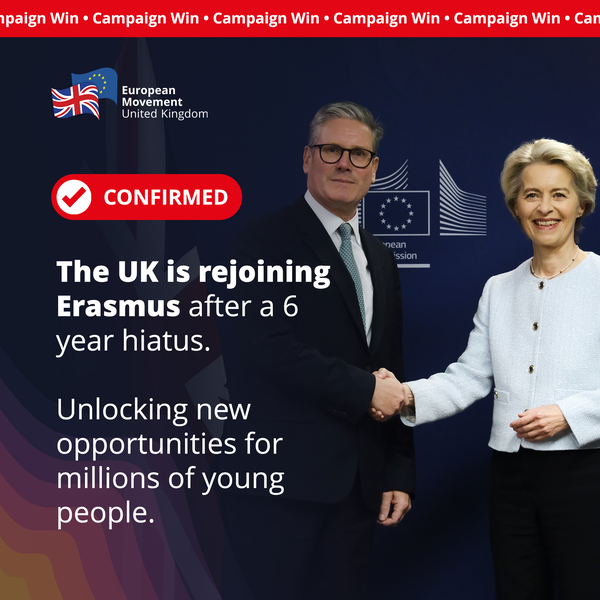
This achievement belongs to every single one of our members, supporters, partners and allies across the country and Europe.
Our movement wrote to MPs, signed petitions, shared stories, organised events, briefed decision-makers and kept the case for Erasmus+ alive. Without our supporters’ energy, commitment and belief, this simply would not have happened.
Being part of Erasmus+ will benefit up to 100,000 people a year - not just students, but apprentices, trainees, adult learners, schools, and more. And it will open up a pathway to more young Europeans spending time in the UK, as well, rebuilding the sense of shared European identity that was snatched away by Boris Johnson’s hard Brexit.
Reacting to the announcement, Alfred Quantrill, 21, President of Young European Movement UK said:
"The news that the UK looks set to rejoin Erasmus+ is very welcome, and long overdue. Young Brits deserve the same chances enjoyed by most of their peers across the continent.
"A commitment to the Erasmus+ Scheme will reopen doors for British young people through education. It will also mean opening up broader access to apprenticeships, internships, and leisure.
"While our parents could freely work, study and travel across borders, my generation is trapped by lost opportunities, red tape and high costs. Erasmus+ is a chance for the Government's to fix this failure."
Sir Nick Harvey, CEO of European Movement UK, added:
"This announcement has been hoped for for some time. Alongside a defence pact between the UK and EU, it was seen as a clear pathway towards closer ties in the UK-EU reset announced earlier this year, and a concrete example of thawing relationships.
"The UK's former hostility to the idea could not be justified when the benefits of such a scheme are so obvious. Dismissing the idea simply meant letting down British young people who face all sorts of economic difficulties, and have seen their horizons curtailed by Brexit.
"Young people want and deserve the chance to study or work in Europe. The government owes it to them to make sure they get that chance, and rejoining Erasmus+ is a giant step forwards."
First, we rejoined Horizon Europe. Today, Erasmus+. But it doesn’t end here - next, we look towards a wider youth mobility scheme, then working towards rejoining the Customs Union and Single Market.
The joint statement also said that agreements will be made on bringing the UK into the EU's internal electricity market, a common Sanitary and Phytosanitary (SPS) agreement and on linking Emissions Trading Systems.
The statement reads:
"The Commission and the United Kingdom will proceed swiftly on the United Kingdom's association to Erasmus+ and on the negotiations of the United Kingdom's participation in the internal electricity market of the European Union in accordance with their respective procedures and legal frameworks and in respect of each other's decision-making autonomy.
"The United Kingdom and the European Commission underline their commitment to implementing the outcomes of the May 2025 Summit in a timely manner, and aim in particular by the time of the next EU-UK Summit to conclude the negotiations on the Youth Experience Scheme, on establishing a common Sanitary and Phytosanitary Area and on linking our Emissions Trading Systems."
In the face of the money and resources of our opposition, we are making remarkable progress - and we have momentum on our side to go further, still.
So today we celebrate. Tomorrow, our work continues in building a closer and deeper relationship between the UK and Europe.
Customs Union Bill clears first hurdle in Westminster
December 11, 2025
On Tuesday, Dr Al Pinkerton MP brought a Bill, the UK-EU Customs Union (Duty to Negotiate) Bill, to the House of Commons. The Bill is calling for the government to enter into negotiations on a Customs Union with the EU.
With a remarkable 100 votes for the Bill and 100 votes against, it was a decisive vote (and a rare moment) from Deputy Speaker Caroline Nokes that took the Bill over the line.
Lib Dem leader Ed Davey labelled this as an “historic victory”, but there is a great deal of work to do now. A date for the next reading has been provisionally booked in for January, but Bills brought by opposition MPs usually are not allocated further parliamentary time, so it will likely get stuck there. Plus, the votes against the Bill yesterday show us that there is still nervous resistance to mending our relationship with Europe. For the Bill to progress, it needs government support.
"The prime minister must now listen to Parliament and the public, drop his self-imposed red lines and finally go for proper growth through an ambitious trade deal with the EU," Davey added.
The Green Party of England and Wales stated their support for the Bill.
Deputy PM David Lammy said recently that joining a customs union is "not currently our policy, that's not currently where we are,” but added that Turkey, “which is in a customs union with the bloc, was ‘seemingly benefiting and seeing growth in their economy’”.
Since the budget, it feels like everyone is talking about the need for a serious conversation about rejoining the Single Market and Customs Union. Our movement will continue to do everything we can to keep up the pressure – generating key content on social media, mobilising local groups, speaking to MPs, bringing together the voices of business leaders, getting our message into the media, and more.