
All blogs
-
When Stormont failed us, the ECHR protected us
August 27, 2025
By Pierce Robinson -
Growing up in Enniskillen, a town scarred by the 1987 IRA bombing that killed 11 people, I was reminded daily of how fragile peace can be. After decades of violence, mistrust, and grief, it took years of negotiation - led by the British and Irish Governments with strong support from the USA and the EU - to end The Troubles.
But making peace on paper is one thing; making it work in daily life requires something deeper. That safeguard was the European Convention on Human Rights (ECHR).
Trump-Putin Summit: Ukraine needs to be in the room
August 14, 2025
With Donald Trump and Vladimir Putin preparing to meet in Alaska tomorrow, Europe faces a troubling scenario: the possibility that decisions about Ukraine are made without Ukraine.
Any summit that excludes Kyiv, or treats its presence as symbolic, risks legitimising Russia’s war of aggression and undermining the security of the continent.
Even if we see a late invite for Zelensky to Alaska, being in the room is not the same as having a real voice in the outcome of the talks. A just and lasting peace must be shaped by the people and government of Ukraine. Treating the country as secondary, or as a chattel, sends a dangerous signal. It suggests that territorial conquests are there to be had and that they can be confirmed by sham negotiations, rather than resisted.
It is imperative that both the UK and EU move quickly to deliver on the ambitions of the recently agreed Security and Defence Partnership, building the capabilities needed to defend our values, protect our citizens and shape events in our neighbourhood rather than be shaped by them.
Former Minister for Armed Forces and CEO of European Movement UK, Sir Nick Harvey, said:
“No agreement made over Ukraine’s head, or without restoring its internationally recognised borders, can be called a just or lasting peace.
“The future of Europe cannot be decided in rooms where Ukraine and the EU are absent, and where international law is treated as negotiable. We stand for a peace that is real, fair, and rooted in the principles that keep all Europeans safe.”
Europe, the US and the world must be clear - peace is built on a foundation of Ukraine's making. The conditions for a sustainable peace must include justice for victims, protection for civilians, and the restoration of internationally recognised borders.
Anything less undermines the very fabric of European security and sets a dangerous precedent for the future. This is because the security of Kyiv is inseparable from the security of EU member states in the Baltic and by extension that of Warsaw, Berlin, Paris and London.
It is imperative that the peace and stability of Europe are not and never shall be in the gift of third parties.
UK already benefitting from rejoining Horizon
August 13, 2025
18 months ago, the UK rejoined Horizon Europe - the EU’s £80bn science and research programme - and is already seeing the benefits.
The latest data found that the UK is already “the fifth most successful country in the programme, which is open to 43 nations: the 27 EU member states and 16 non-EU associate members also including New Zealand, Canada and Norway” (The Guardian).
Given the UK only re-entered the programme “three years into the seven-year 2020-27 funding programme”, this is an impressive performance and is great news for the UK.
Plus, “in terms of grants for proposals by individual scientists… the UK now ranks as the second-most successful participating country after Germany”.
Reacting to the news, Dr Mike Galsworthy, Chair of European Movement UK, said:
“Collaboration between European countries provides tremendous added value. Nowhere was this more apparent than in the global science programme run by the EU, Horizon.
“The UK used to joint lead, with Germany, for funds won and used to dominate on project leadership. Brexit put the boot into that and set us back hugely.
“The recovery is now underway, but will take time - and we’ve already lost an eye-watering chunk of projects and talent for it.
“The UK re-entering Horizon Europe can be a blueprint for re-entering the other programmes, bodies and agreements which will bring untold benefits to the UK, such as Erasmus+, the EU Single Market and the European Union itself.”
UK shut out of Europe's climate data network as fourth heatwave hits
August 12, 2025
As the UK faces its fourth heatwave of the summer this week, new analysis from European Movement UK warns the country is less prepared for climate and environmental risks after losing membership of the European Environment Agency (EEA) and access to its Environmental Information and Observation Network (Eionet).
These institutions form the backbone of Europe’s environmental early warning systems, pooling data from 32 countries and the European Commission. They provide real-time monitoring on air and water quality, biodiversity, greenhouse gas emissions, and the health impacts of pollution - intelligence that helps governments anticipate and plan for events such as heatwaves, flooding, and wildfires.
Since leaving the EEA and Eionet, the UK no longer participates in their coordinated dataflows or has access to the privileged channels members use to share detailed, timely information. It has also lost its seat in shaping EU-wide monitoring and reporting standards. This has left gaps in the UK’s environmental intelligence and made it harder to anticipate emerging risks.
Sir Nick Harvey, CEO of European Movement UK, said:
“Environmental threats don’t stop at our borders. Losing access to the EEA and Eionet means we’ve cut ourselves off from the best environmental data in Europe, making it harder to prepare for climate change, biodiversity loss, and pollution. We should be inside these networks, sharing expertise and helping shape solutions.
“Outside of the EU, it is perfectly feasible to be a member - other non-EU countries such as Norway and Iceland already are.”
The report calls for the UK to negotiate re-entry to the EEA and Eionet, restoring direct access to shared environmental intelligence and ensuring UK expertise is once again at the heart of Europe’s climate and environmental planning.
New poll shows only 29% support Brexit
August 04, 2025
Released over the weekend, the latest polling in The Times revealed that only 29% of the British public would vote Leave if a referendum were held today, marking a major shift in public opinion.
Sir Nick Harvey, former Minister for Armed Forces and CEO of European Movement UK, said:
"Whether it is the cost of living, issues with the NHS, or concerns over a loss of control on immigration - all of these concerns can be met more effectively by the UK working more closely with our neighbours in the European Union.
"This polling signals a clear and decisive change in the British public’s attitude towards Europe. This the latest sign that the heat has been taken out of the debate.
"Our movement is leading the charge to bury Brexit for good and turn the chapter on the UK-EU relationship."
EU-US trade deal - what we know
July 28, 2025
Over the weekend, the European Union and the United States agreed the basis for a trade deal at President Trump’s golf course in South Ayrshire, Scotland. Trump dubbed it “the largest trade deal in history”.
This is a fast-moving situation, but here is what we know so far, and what the key players have said.
Before the meeting on Sunday, the EU was set to face 30% US tariffs “on most EU goods” from 1st August.
Afterwards, European Commission President Ursula von der Leyen released a statement, saying:
“Today's deal creates certainty in uncertain times.
“We have stabilised on a single 15% tariff rate for the vast majority of EU exports (into the US). This rate applies across most sectors, including cars, semiconductors and pharmaceuticals.
“Today we have also agreed on zero-for-zero tariffs on a number of strategic products. This includes all aircraft and component parts, certain chemicals, certain generics, semiconductor equipment, certain agricultural products, natural resources and critical raw materials.
“And we will keep working to add more products to this list.
“On steel and aluminium… We will work together to ensure fair global competition. And to reduce barriers between us, tariffs will be cut. And a quota system will be put in place.
“We will also increase our energy cooperation… We will replace Russian gas and oil with significant purchases of US LNG, oil and nuclear fuels.
“US AI chips will help power our AI gigafactories and help the US to maintain their technological edge.
On the deal, President Trump said:
“We have reached a deal. It's a good deal for everybody.
"It's going to bring us closer together" (BBC News).
The new US 15% tariff that US buyers will pay on EU products is the same as on Japanese goods, whilst the UK faces a 10% tariff on most products.
As it stands, from 1st August the UK will face tariffs including:
- 25% on steel, aluminium and automobiles
- 10% on auto parts (which came into effect in May)
- Up to 50% on copper (Wise).
There is no getting away from the fact that President Trump’s move has been a success in US domestic political terms. Imposing selective tariff barriers to ‘protect’ key industries has long been a desire of the America First movement and Trump has done this while avoiding the catastrophic damage to the US and global economies that a 30% tariff would have caused.
Neither has he faced significant retaliation from trading partners, except China. This will skew the terms of global trade in the US’ favour.
But that does not mean there will be net benefits to the US economy - these are additional trade barriers that will damage all sides.
Furthermore, any claims made in the UK that these tariff outcomes somehow justify the UK leaving the EU are incorrect.
In 2021, the UK Trade Policy Observatory estimated that £2.5–3.5 billion worth of UK exports were hit by EU tariffs in the first year after Brexit. Now, about 10% of UK exports to the EU face tariffs for varying reasons.
Much remains unclear about the final details of both the UK and EU deals with the US. But one thing is certain. If being hit slightly less hard than the EU by US tariffs represents any marginal gain for the UK, it will be a tiny fraction of the massive cost of being outside the EU single market - which is between 3% and 5% of GDP every year.
Expect more developments on this story.
Keir Starmer: UK musicians and artists 'Finding it too difficult to work in EU'
July 22, 2025
Prime Minister Keir Starmer has said musicians and artists from the UK are still finding it too difficult to work in the EU. The clip is viewable here.
Speaking on Monday to the Liaison Committee, the Prime Minister said that resetting the UK's relationship with the EU now meant there was 'a chance of going further' for UK artists.
European Movement UK has been campaigning for the Government to take action on touring visas to help artists who have seen work in the EU dry up since the UK left the European Union.
Find out more about our Face The Music campaign here, and watch first-hand stories of artists affected here.
Keir Starmer told the committee:
"I think many creative people who are crossing borders for their artistry, their music, whatever it may be, on a temporary basis, they're not going to another country for any significant period of time, they're still finding it too difficult to get in and out of a country and I hope we can make some progress there.
"These are common sense changes we could make to our arrangements with the EU, which had in my view very little to do with the vote in 2016, and where by resetting the mood in Europe we now have a chance of going further."
Actor Miriam Margolyes has teamed up with European Movement UK to highlight the plight of musicians and touring artists trying to work in the EU.
In a short animated film, she explains the effects leaving the European Union has had on the industry.
You can watch the film here:
Miriam Margolyes said:
"Brexit is not just a political disaster, it's a cultural one too, especially for our beloved artists. Brexit was a terrible mistake and no-one will own up to it. Art feeds the soul of a nation. Brexit starves that soul."
European Movement UK launches campaign for stronger UK-EU Energy, Climate and Environment Partnership
July 17, 2025
On Wednesday evening, leaders from across politics, industry and civil society gathered at Broadway House, London for the launch of the European Movement’s latest report, A New Agenda for UK–EU Energy, Climate, and Environment Cooperation, and a wider national campaign calling for a UK-EU Energy, Climate and Environment Partnership.
Just weeks after the pivotal UK–EU Summit in May, the event set out to seize the momentum from renewed agreements on energy security, emissions trading, and climate cooperation.
The panel, chaired by Caroline Lucas, Co-President of the European Movement UK, brought together prominent voices including former Energy and Climate Secretary Amber Rudd, Energy UK’s Chief Executive Dhara Vyas, Green Alliance’s Sarah Williams, Emilien Gasc from the EU’s UK delegation, and Young Greens’ Thomas Atkin-Withers.
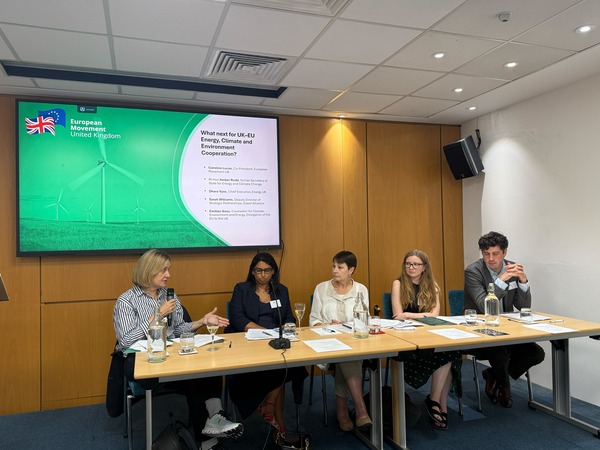
Each speaker outlined the critical importance of closer UK–EU collaboration on clean energy, aligning carbon markets, and restoring nature across borders.
Now, the campaigning begins. We are all hands on deck to ensure that our policy recommendations feature at the next UK–EU Summit.
New Report: UK voters support a new UK-EU Climate Partnership to lower energy bills and protect the environment
July 16, 2025
Today, European Movement UK has launched a major new policy report - and a wider national campaign - calling for a UK-EU Energy, Climate and Environment Partnership.
Exclusive data from new polling commissioned by European Movement UK reveals a clear and growing public consensus:
- 67% of UK voters want Britain to work with other countries to tackle climate change
- 69% support international action to prevent environmental damage
- 71% would support a formal UK-EU partnership to reduce energy bills and harmful chemicals, even if it meant applying some EU rules
The European Movement's latest report outlines a four-pillar Partnership to deliver practical, lasting benefits for the UK:
- Linking carbon markets and rejoining the EU Internal Electricity Market
- Full UK membership of the North Seas Energy Cooperation
- Alignment on environmental and chemical safety standards
- Rejoining strategic EU agencies and programmes -including the European Environment Agency and the LIFE Programme - to restore access to vital data, funding, and scientific collaboration.
Caroline Lucas, Co-President of European Movement UK, said:
“A UK-EU Green Partnership would deliver exactly what people want - a greener, healthier future.
"It would also cut climate emissions and lower household energy bills, protect and restore our shared environment and public health, and secure a seat at the table in shaping the rules that affect us. Above all, it would show that cooperation - not isolation - delivers for people and planet alike.
"Since leaving the EU, we’ve seen mounting and damaging divergence. The consequences are already being felt - in the decline of nature, rising bills, and even in the food on our plates. In some cases, the level of glyphosate - classified by the WHO as a ‘probable human carcinogen’ - is now 7.5 times higher in the UK than in the EU.
"We need the political courage to do what’s right. The time to act is now.”
Sir Nick Harvey, CEO of European Movement UK, added:
“This new Partnership is not just about rebuilding relationships - it’s about unlocking real economic benefits for the UK.
"By aligning with higher EU standards and rejoining key programmes, the UK can unlock green investment, support British exporters, and avoid billions in costs from duplication, divergence, and future tariffs.
"European Movement UK is proud to be leading the campaign for a credible, cooperative and future-facing relationship with Europe - and this report shows how we can get there.
"Voters are ready. Business is ready. Westminster needs to catch up.”
Find out more on the campaign page and join the call on the UK Government to work to join a UK-EU environmental partnership.
Macron's State Visit to UK - Is This Progress?
July 11, 2025
This week saw the first state visit by a European head of state to the UK since Brexit.
That sentence in itself speaks volumes, both about how damaging the vote to leave the EU was to the UK's relationship with its closest neighbours - but also showing concrete evidence that the frost is very much beginning to thaw.
Emmanuel Macron and Sir Keir Starmer have, it's reported, met multiple times since the PM came to power just over a year ago. 'Closer ties' and a 'relationship reset' are phrases much-used since then, regarding Britain's relationship with EU member states.
But while defence, a youth experience scheme and waiting times for UK passport holders have all filled hundreds of column inches, there are few things which anyone wanting much closer ties between the UK and EU can actually put their finger on and say, unequivocally, 'that's progress.'
But, perhaps, this week's state visit has finally changed that.
On July 10th the Government announced 'Lancaster House 2.0': a declaration on modernising UK-French defence and security cooperation. It has no doubt received far less press attention that it deserves - most of the headlines have been about the '1-in-1-out' trial for dealing with the small-boat crisis. But it is real change, and the concrete cooperation so many are looking for that signals the new openness from the UK to the EU, after years of sulking in the corner.
The declaration says, 'The UK and France are willing and able to act together, decisively, to protect our shared interests, allies, partners in Europe and beyond, values and, fundamentally, our democratic way of life.'
That sentence feels like one we've been waiting for: friends again.
The declaration is wide-ranging, but among other things, it will see the creation of a Combined Joint Force, overhauling the current Combined Joint Expeditionary Force and seriously increasing its capacity ('up to fivefold'). It also says it will establish a 'mechanism to share, coordinate and synchronise military activity and the deployment of UK and French forces globally.'
That suggests that such a mechanism does not yet exist - and creating one allies the UK to France, and the wider EU, in ways that are difficult to predict - but at the very least, it is the opposite of Brexit on a fundamental level: a recognition that we are stronger together, not apart.
Amongst the formal dinners ('a mixture of French and English cuisine'), royal audiences and accompanying pomp, there was a lot more on display here than the headlines suggest.
With Labour's red-lines on the single market and customs union, the 'relationship reset' between the UK and the EU has had little but warm words to be celebrated for the past twelve months.
But, perhaps now, we can finally start to say, 'that's progress.'